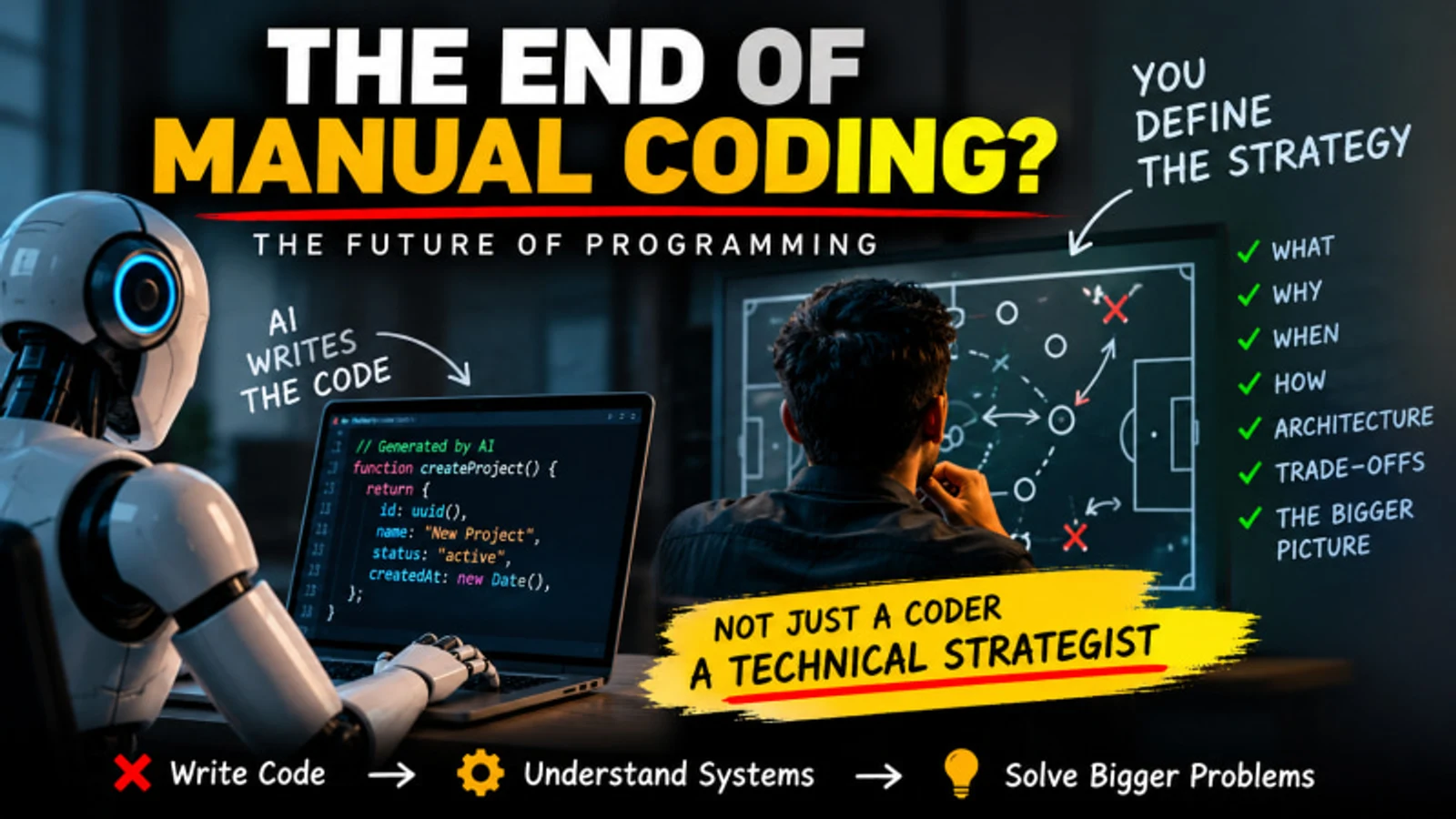
The era of writing every line of code by hand is slowly coming to an end.
AI can already generate code faster than most developers, and it is becoming surprisingly capable at finding bugs, reviewing implementations, and suggesting improvements. As these systems continue to evolve, even traditional code review will require less human involvement.
So, does that mean we no longer need to learn programming?
Quite the opposite.
We still need to understand programming—but the way we learn it has to change.
For years, learning programming meant spending countless hours writing syntax, memorizing APIs, debugging errors, and building things line by line. That approach made sense when humans were responsible for producing the code.
But if AI is going to handle much of the implementation, our focus needs to move from writing code to understanding systems.
Think about an architect. An architect doesn't need to personally lay every brick, install every pipe, or wire every electrical connection. Their job is to understand the entire structure—how different parts fit together, where problems might occur, what materials should be used, and how everything should work together.
They understand the system so they can make the right decisions.
The same shift is happening in software development.
AI may write the implementation, but someone still needs to decide:
- What should be built?
- Why should it be built this way?
- How should the system behave?
- Which architecture makes sense?
- What trade-offs are acceptable?
- How should different components interact?
- What could go wrong?
That person needs to understand programming deeply enough to make those decisions—even if they aren't personally typing every line.
In other words, the developer of the future may look less like a traditional coder and more like a technical strategist or team lead.
So don't stop learning programming.
Instead, change what you are learning programming for.
Learn the logic, architecture, systems, patterns, trade-offs, and problem-solving behind the code.
Because the future may not belong to the people who can write the most code.
It may belong to the people who understand what code needs to exist—and why.